



































Development Centre
Making progress visible –
tailored assessment meets specific learning opportunities.
A Development Centre (DC) provides your staff, specialists and managers with a development-focused assessment of their skills and potential, detailed feedback on their strengths and areas for development – and recommendations for specific next steps in their development. We combine simulations, validated tests and elements of learning and reflection into a format that is precisely tailored to your specific needs.
- Development-oriented assessment rather than mere selection
- Detailed feedback on strengths and areas for improvement, specific recommendations for development
- A combination of simulation exercises, tests, reflection and learning
- Can be delivered as a group or individual programme, lasting one or more days, in person or remotely
- Follow-up, e.g. reflective discussion, written report, development plan
Trust from companies, the public sector and academia


When a development centre is the right choice

Would you like to provide tailored support for the personal development of your staff and managers?

Do you want to identify high-potential employees and prepare them for upcoming professional challenges?

Would you like to help employees decide whether a specialist or management career path is the right one for them?

Do you want to encourage personal responsibility and empower staff to take charge of their own development?
That’s where a Development Centre provides a solid foundation of information – and development guidance that can be put into practice straight away.
These principles are what make a development centre a success
Development Centres combine scientifically sound, nuanced assessment with learning opportunities – thereby making a measurable contribution to a company’s success: greater staff retention, higher satisfaction and improved performance.
Differentiated feedback at eye level
Feedback from multiple perspectives – from observers, the facilitator and colleagues – provided in short bursts immediately after the exercises. The more varied the feedback, the more resilient the self-image.
Focus on strengths rather than weaknesses
In line with the principles of positive psychology, we highlight strengths and demonstrate specifically how they can be developed in a targeted manner.
Ensuring relevance to everyday life and transferability
The exercises simulate typical situations that are critical to success – such as conversations or meetings. This ensures that the skills can be applied in everyday working life.
A wide range of methods from a single source
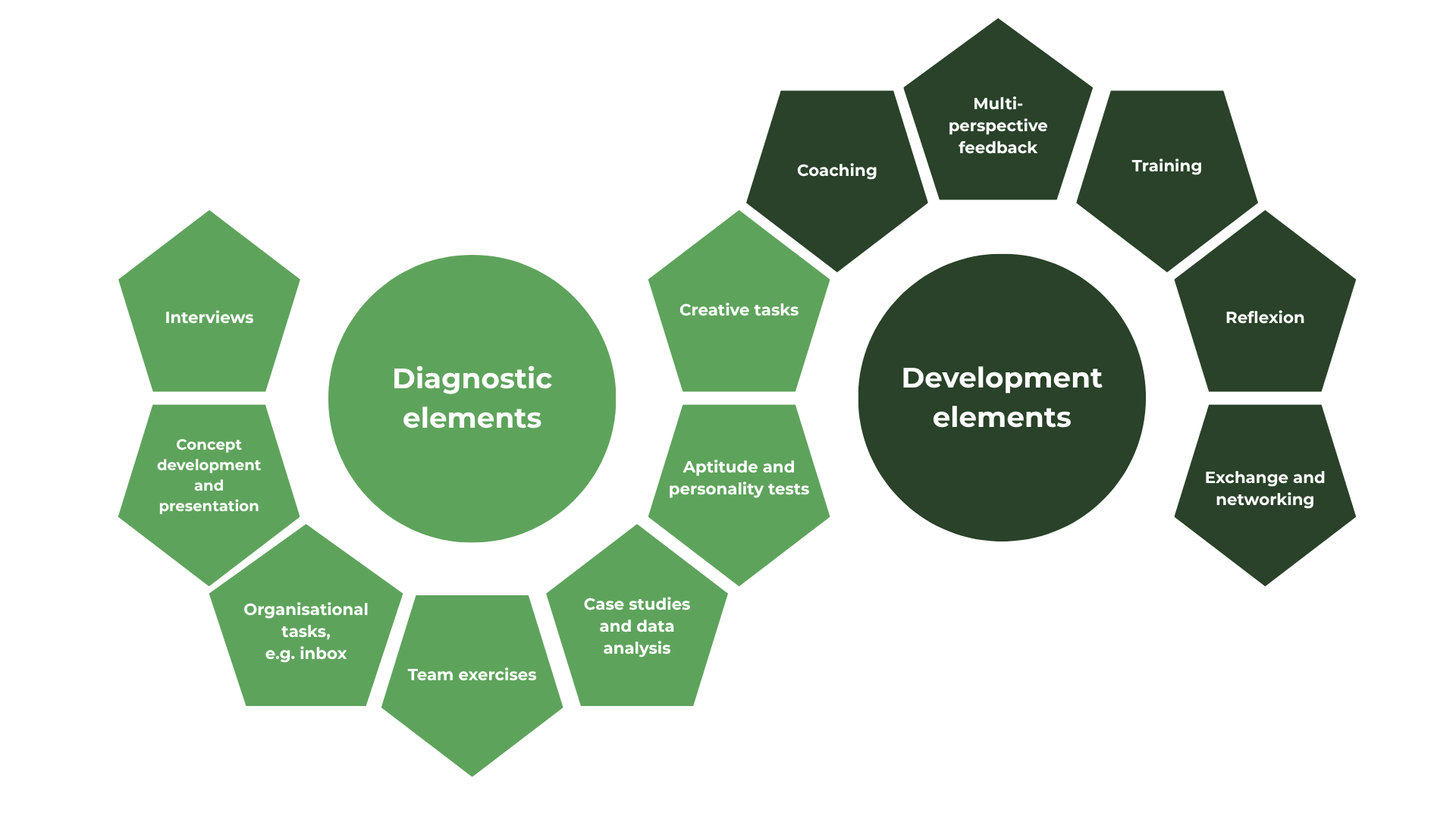
We combine behavioural simulations, personality questionnaires and performance tests from our IONA platform, along with reflective exercises, with training and coaching sessions.
Aligned with the organisation’s objectives
Skills relevant to the future, practical exercises and alignment with the organisational culture – all geared towards achieving strategic objectives.
Flexible in format
One-day or multi-day courses, delivered in person, remotely or via a hybrid format, as group or one-to-one sessions – GDPR-compliant and, if required, entirely paperless.
How to integrate a variety of aptitude assessment elements into a digital journey
Tailored to your needs, with a high degree of flexibility for participants
Time is a scarce resource. Anyone wishing to attract and retain the best talent today needs an assessment tool that is flexible, provides precise and valid measurements, and offers a seamless digital experience.
We’d like to introduce you to our new, modular concept and show you how you can integrate aptitude assessment elements into a digital journey – all within a single central interface, in line with your corporate design and with consolidated reporting.
Dates:
3 September 2026, 3:00–4:00 PM (CEST)
Feedback sequences
Constructive feedback immediately after exercises and during reflection sessions.
Learning opportunities
Short, interactive training sessions – for example, on leadership, diversity or feedback.
Coaching sessions
Targeted coaching guidance – self-reflection, harnessing strengths and developing practical steps for immediate action
From requirements analysis to the development plan
This is how a Development Centre works with ITB.

Kick-off & Requirements Analysis
Clarifying objectives, defining requirements and skills, project communication

Design & selection of components
A tailor-made selection of DC exercises, online tests and learning resources – developed in close consultation with you.

Training & Implementation
Training for participants; clarifying the roles of the facilitators – as moderators, observers, coaches or trainers.

Feedback & Consolidation of Results
Detailed feedback from multiple perspectives; summarising the results in a report or during a reflective discussion

Next steps
If required, we can continue to support the implementation process – for example, through coaching, training sessions, workshops or evaluation.
A win-win situation for everyone involved
For participants
A clear understanding of one’s own profile, reconciling one’s self-perception with how others perceive one, and a solid foundation for career decisions and prioritising development initiatives.
For observers
Strengthening their skills in observing behaviour and providing feedback; increasingly also in their role as sparring partners. We prepare them specifically through specialised training courses.
For businesses & HR
A clear overview of existing potential, targeted support for staff, and greater satisfaction and loyalty.
A DC can be tailored to a homogeneous group (e.g. team leaders before they move into departmental management) or deliberately structured to be heterogeneous – in which case the focus shifts to cross-departmental networking and ‘thinking outside the box’.
The end result is a practical development plan – and motivated staff
Drawing on specialist expertise and extensive industry experience, we produce a practical report that outlines strengths and areas for development. In line with the principles of positive psychology, we demonstrate how strengths can be further developed. The recommendations are designed for on-the-job application and can be implemented immediately – which boosts motivation and loyalty to the company.
FAQ
What is the difference between a development centre and an assessment centre?
An assessment centre focuses on how well a person meets relevant requirements – for example, for a specific role or target level. To this end, typical, challenging and critical situations encountered in a professional role are simulated, and the competencies demonstrated are assessed in detail with regard to these requirements. It is primarily used for staff selection.
A development centre is development-oriented: in addition to current skills, it also considers the potential to tackle future challenges and combines assessment with feedback, self-reflection and appropriate learning opportunities. It is primarily used in staff development.
The boundaries between assessment and development centres are fluid. We can advise you on which format best suits your objectives, organisational culture and target group.
When is a Development Centre appropriate – and when are Systemic Development Days a better option?
A Development Centre is appropriate when the focus is on development-oriented assessment: strengths and areas for development are identified in a nuanced way through simulation exercises, assessment procedures, reflective activities and learning prompts. It is particularly valuable when the aim is to utilise multiple observation perspectives, feedback and peer learning within the group.
Systemic Development Days are suitable when the focus is more on individual self-assessment, self-management and career guidance. The benchmark here is not so much a specific job requirement as the individual themselves – with a focus on resources, a diversity of perspectives, feedback and personal responsibility.
Should development centres be run as group or individual sessions?
This depends on the objectives, the target level and the circumstances. Development centres are often conducted as group sessions with participants facing similar challenges – for example, as part of a talent programme. The advantage is peer learning and feedback from multiple perspectives. If the circumstances are not suitable – for instance, where there are few participants, higher target levels or a remote setting – an individual assessment may be more appropriate.
In person or remotely – and what does ‘paperless’ mean?
Both options are possible: on-site or virtually from a distance. International procedures are often carried out remotely to reduce travel time and costs. We use a digital, GDPR-compliant observation record that captures all relevant documents and assessments in a paperless format – making it efficient, well-structured and easy to manage.
How long does a Development Centre last?
The duration depends on various factors – including the objectives, the number of participants and observers, the resources available, the venue, and the desired balance between learning, reflection and networking. Accompanying activities such as informal get-togethers, shared meals or supporting programmes, e.g. guided tours, can also encourage interaction. We will determine the appropriate scope together during the initial consultation.
What does the results report say?
The scope and content of the results report are tailored to your needs – ranging from a profile chart with a brief assessment of potential and a summary of key strengths and areas for development, right through to detailed reports with examples of behaviour relating to individual competencies. In addition, we provide specific, practical development guidance. In line with our strengths-based approach, we also highlight how existing strengths can be utilised even more effectively.
Our recommendation: The results should not be confined to the report alone, but should be explored in greater depth during reflection sessions. During these sessions, participants summarise their key insights themselves and identify specific next steps.
Which target groups is a DC suitable for?
For staff, specialists and managers at all levels – for example, to prepare for new roles, to identify high-potential individuals, or to help them decide between a specialist or management career path.
How are observers prepared?
Observers are increasingly taking on the role of sparring partners: they help participants to make sense of feedback, identify opportunities for development and strengthen the transfer of these insights into their everyday lives. This can foster a relationship of trust that extends beyond the Development Centre.
How does the collaboration with ITB work?
We structure our collaboration flexibly and on an equal footing, and work with you to agree on how you would like to work with us – for example, with a clear division of labour or through co-creation. With a clear division of labour, we implement everything for you based on the project brief and incorporate your feedback during regular coordination meetings. In a co-creation approach, we contribute our diagnostic expertise and an external perspective; you provide the internal perspective and take charge of implementation where it suits you best. Together, we clarify roles and communication channels, and use collaboration platforms such as Teams where necessary. What matters to us is professional quality, reliability – and a human connection that is also enjoyable.
Let us design your Development Centre!
Would you like to identify potential in a well-founded way, tailor development measures more precisely, or nurture talent in a targeted manner? In a no-obligation discussion, we’ll show you what a Development Centre could look like for your target group.